In the production workshop of metal die-casting industry, the deburring process has long been regarded as a process link that is difficult to completely tame. Operators hold pneumatic tools or sandpaper, bend over the workpiece in a noisy environment, and remove the fine metal flash and burr from the mold line and gate of the casting bit by bit with naked eye observation and hand experience. This mode, which is highly dependent on manual operation, is not only inefficient and has a ceiling in productivity, but also faces multiple challenges such as difficulty in guaranteeing quality consistency, high labor intensity, high occupational health risks and rising labor costs. Especially for aluminum-zinc alloy die castings with complex structure, deep cavity and relatively soft material, the traditional manual or semi-automatic deburring methods are even more inadequate, which are prone to excessive grinding, body damage, omission of burrs or uneven surface treatment, and become a significant bottleneck restricting product quality improvement and intelligent upgrading of production lines. However, with the maturity and popularization of high-end automation solutions represented by six-axis linkage deburring technology, a precision revolution aimed at "fighting for every inch" and completely saying goodbye to the era of "manual grinding" is reshaping the future prospects of this key process. 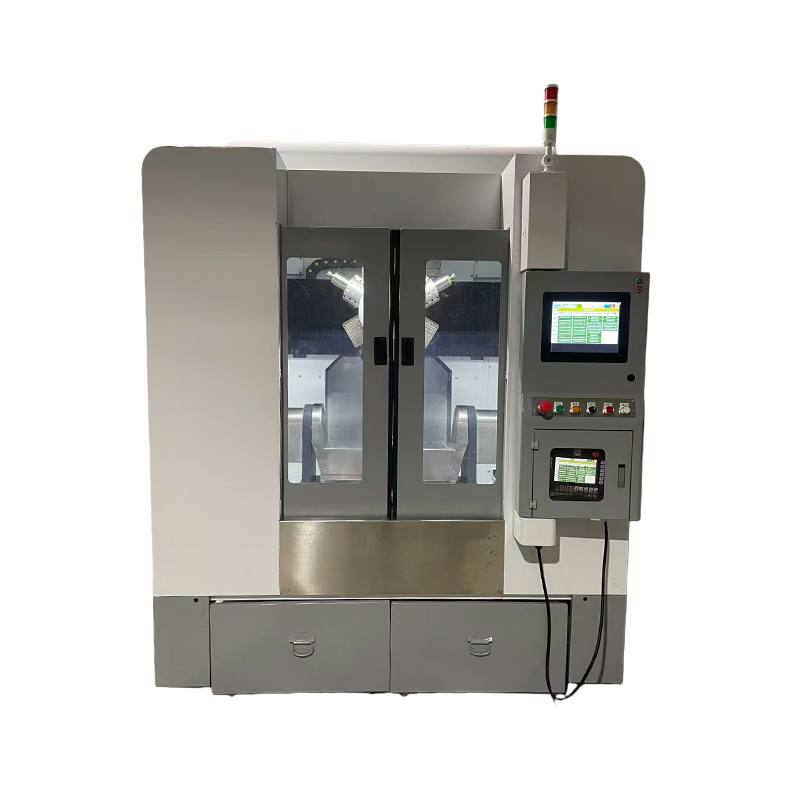
The Difficulty of Traditional Deburring: The Triangle Problem of Efficiency, Quality and Cost
Efficiency Ceiling and Consistency Dilemma of Manual Operation
Under the traditional production mode, the deburring process relies heavily on the operation skills and concentration of skilled workers. Each worker is an independent and fluctuating "production unit", whose work efficiency is affected by physical strength, energy, mood and even the state of the day. For die castings with complex shape and hidden burr distribution, thorough cleaning often requires repeated inspection and multiple processes, and the processing time of unit product is long, which directly restricts the rhythm and capacity limit of the whole production line. More importantly, manual operation can hardly achieve absolute quality consistency. There are slight differences in the intensity, angle and range of grinding between different workers and even between different batches of workpieces handled by the same worker, which can easily lead to insufficient removal of some products (residual burrs affect assembly and safety) and excessive removal of others (damage to the structure or dimensional accuracy of workpieces, resulting in waste products). This uncertainty brings potential risks to subsequent assembly, electroplating, spraying or product performance, and becomes an unacceptable quality variable in high-end manufacturing.
Rising combined costs and sustainability challenges
On the surface, manual deburring seems to have low equipment investment, but its comprehensive cost is rising sharply. Firstly, the global manufacturing industry is generally facing the pressure of shortage of skilled workers and rising labor costs, and the process relying on manpower has directly become the difficulty of cost control. Secondly, metal dust, noise and repetitive physical labor pose a threat to workers'health, which makes enterprises have to invest more resources in labor protection, environmental governance and occupational health management, and bear the corresponding compliance risks. Moreover, the rework, scrap, and potential customer complaints and quality claims caused by inconsistent manual operations constitute a huge hidden cost. In the long run, a process link that relies heavily on non-replicable and difficult to standardize human resources has become a prominent obstacle to large-scale expansion, digital management and industry 4.0 of enterprises, and its sustainability is facing a severe test.
Six-axis linkage technology: endowing machinery with "bionic" precision and flexibility
Breaking through the Limit of the Degree of Freedom: the Space Motion Philosophy of Six-axis Linkage
Unlike traditional three-axis or simple rotary fixture equipment, the core of six-axis simultaneous deburring technology lies in the superior flexibility of its motion system. The so-called "six-axis" usually refers to the six joint degrees of freedom of industrial robots, which simulate the complex movement ability of human arm from shoulder, elbow to wrist, and even surpass it. This enables deburring tools (such as high-speed spindles, flexible grinding heads, scrapers, etc.) installed at the end of the robot to approach the three-dimensional surface of the workpiece at almost any angle and any trajectory. Whether it is the inner wall of a deep cavity, a narrow groove, a tortuous hole, or a complex surface with extremely irregular shape, the six-axis robot can guide the tool to work accurately along the preset optimal path to achieve "no dead angle" tracking and removal of burrs. This full space accessibility is the key to solve the problem of deburring of complex aluminum-zinc alloy die castings, which breaks the processing blind area of traditional equipment due to the limitation of motion dimension.
Force Control and Perception: From "Blind Grinding" to "Intelligent Feeling"
The ability to move flexibly is not enough to cope with the randomness of burrs and the subtle tolerance fluctuations of the workpiece itself. The advanced six-axis simultaneous deburring system integrates high-precision force/torque sensors and adaptive control algorithms. When working, the sensor monitors the magnitude and direction of the contact force between the tool end and the workpiece in real time. The system no longer relies on the rigid assumption that the size of the workpiece is absolutely consistent, but intelligently adjusts the feed speed, attitude and even pressure of the robot by "sensing" the change of the contact force, so as to ensure that the burr is removed without overcutting or damaging the workpiece body. This is like giving the mechanical arm a precise "touch", making its operation mode leap from "blind grinding" to "intelligent touch", which can gently and firmly handle every feature, perfectly adapt to the soft and deformable characteristics of aluminum-zinc alloy material, and realize the adaptive processing oriented by constant process quality.
Digital Twins and Offline Programming: The Engine Behind the Efficiency Transition
Another great leap forward in technology is reflected in the intellectualization of process preparation and switching. Based on 3D digital twin technology, engineers can analyze the burr characteristics of the CAD model of the workpiece in the virtual environment, and directly plan optimal and collision-free machining path for the six-axis robot. This process is done through off-line programming software, without taking up valuable production line real time. After the program is generated, it can be downloaded to the robot controller with one click. When the production line is changed and another workpiece is processed, the robot can quickly switch tasks only by calling the corresponding program file. This completely changes the long process of debugging, trial grinding and fixture adjustment in the traditional manual or special machine mode, makes it possible to produce flexibly in small batches and varieties, and pushes the efficiency of the production line to a new height.
100% jump in efficiency: not just speed, but system refactoring
Linear Release of Production Capacity and Reshaping of Takt Time
With the six-axis linkage automatic deburring unit, the most intuitive benefit is reflected in the leap-forward growth of production capacity. Robots can work 7x24 hours without interruption, tirelessly, always performing tasks at a constant speed and precision, eliminating the limitations of artificial physiological cycles. Its high-speed and coherent trajectory greatly shortens the processing time of a single product. In practice, in the deburring process of many aluminum-zinc alloy die castings (such as automotive parts, 3C product structural parts, high-end tool shells, etc.), it has become normal to achieve 100% or even higher production efficiency than traditional manual mode. This is not only the acceleration of the speed of a single station, but also the dredging of the bottleneck process of production, which reshapes the rhythm of the whole production line, releases the potential capacity of the previous processes such as die-casting and machining, and brings about a systematic leap in the overall output efficiency.
Quality Consistency: Create the Process Foundation of "Zero Defect"
Automated systems eliminate manual instability and solidify proven optimal process parameters (e.g., path, speed, pressure) into the program. Each product receives exactly the same process, and the results are highly predictable and repeatable. The uniformity of burr removal and the consistency of surface texture are fundamentally guaranteed, and the variation of key dimensions of the workpiece is controlled at micron level. This not only greatly reduces the rework rate and scrap rate, but also improves the product quality to a new level of "zero defect" orientation, which wins the crucial quality reputation for enterprises in the high-end market competition, and significantly reduces the after-sales risks and costs caused by quality fluctuations.
Paradigm Shift of Comprehensive Cost
From the perspective of total cost of ownership (TCO), the six-axis linkage automation solution brings about the optimization of cost structure and paradigm shift. Although the initial equipment investment is higher than that of simple tools, the return on investment cycle is becoming shorter and shorter. It directly reduces the high and growing direct labor costs and significantly reduces labor-related administration, training, insurance, and health care expenses. In terms of quality cost, the reduction of scrap rate and rework rate has brought considerable savings. At the same time, the long-term stable operation and low failure rate of the equipment ensure the continuity and planning of production. More profoundly, it liberates enterprises from the dependence on scarce skilled workers, makes the expansion of production capacity no longer subject to the bottleneck of human resources, and lays a solid foundation for the large-scale and flexible development of enterprises in the future.
Deep application: the perfect solution for complex Al-Zn alloy die castings
Overcoming the Challenges of Complex Geometry
Aluminum-zinc alloy die castings are widely used to manufacture parts with complex shape, thin wall and delicate structure because of their excellent fluidity and formability. These components often have numerous stiffeners, shaped holes, internal cross runners, and complex curved surfaces. Six-axis linkage technology, with its spatial freedom advantages, can easily handle these geometric challenges. The robot tool can subtly probe into the narrow space and precisely walk along the edge of the rib; it can adjust the posture to clean flash at the bottom of the deep hole at the best angle; it can follow the change of the curvature of the curved surface to polish at a uniform speed and constant force to obtain a smooth and consistent surface effect. This is beyond the reach of any special plane or person with a fixed track.
Respond to material properties to achieve a perfect surface
Aluminum-zinc alloys are relatively soft and ductile, and burrs tend to appear as ductile flash rather than brittle fracture. Traditional strong grinding can easily lead to burr lodging, material accumulation or body damage. The six-axis linkage system with high-frequency electric spindle and special diamond or ceramic grinding tools can "cut" rather than "roll" at a very high linear speed to remove burrs cleanly, while generating very low cutting force and heat to avoid workpiece deformation or surface hardening. Sophisticated force control ensures a slight and constant contact between the tool and the surface, providing a perfect base for possible subsequent surface treatment processes such as anodizing, spraying or electroplating.
Seamless integration in intelligent production line
At the beginning of the design of the modern six-axis deburring workstation, the integration needs of the production line were considered. It can be seamlessly docked with automatic loading and unloading systems (such as joint robots, AGV), visual recognition and positioning systems, and production line MES systems. The workpiece arrives at the station through the conveyor line, the vision system carries out precise positioning compensation, and the robot automatically places the workpiece in the blanking area after grasping and deburring. The whole process has no human intervention and real-time data upload, which realizes the comprehensive automation, informatization and intellectualization of the deburring process, and becomes an efficient, reliable and transparent process node in the digital factory.
Facing the future: beyond the process platform of deburring
The significance of six-axis linkage technology is far more than innovation of the single process of deburring. It essentially provides a highly flexible and intelligent platform for precision surface treatment. The same system can be easily extended to adjacent processes such as chamfering, polishing, cleaning, burr detection and even small precision assembly after changing the end tool and process program. This flexibility of "one machine for multiple purposes" further improves the return on investment of equipment and provides unprecedented possibilities for the optimization and continuous upgrading of the process layout of the factory.
Embrace change and win by inches
Today, with the rapid development of high-end and intelligent manufacturing industry, the accuracy of process details determines the ultimate value and market competitiveness of products. Deburring, which was once regarded as an "auxiliary" process, is coming to the center of the manufacturing stage with its decisive impact on product reliability, safety and aesthetics. Six-axis linkage deburring technology, with its free control of space, insight into subtle force and integration of digital intelligence, accurately responds to the triple call of the times for efficiency, quality and flexibility.
It not only replaces manual labor with robots, but also replaces uncontrollable experience with reproducible precision algorithms, and replaces fluctuating fatigue with permanent stability. When the efficiency of the production line is doubled because of its addition, when the quality of the product is improved because of its processing, and when the enterprise is more resilient because of its empowerment, we can clearly see that saying goodbye to the era of "manual grinding" is not a simple technological substitution, but a profound cognitive and system upgrade for future manufacturing. It is the core essence of modern intelligent manufacturing to win in the slightest. Embracing this precision revolution led by six-axis linkage means embracing a more efficient, high-quality and sustainable manufacturing future.